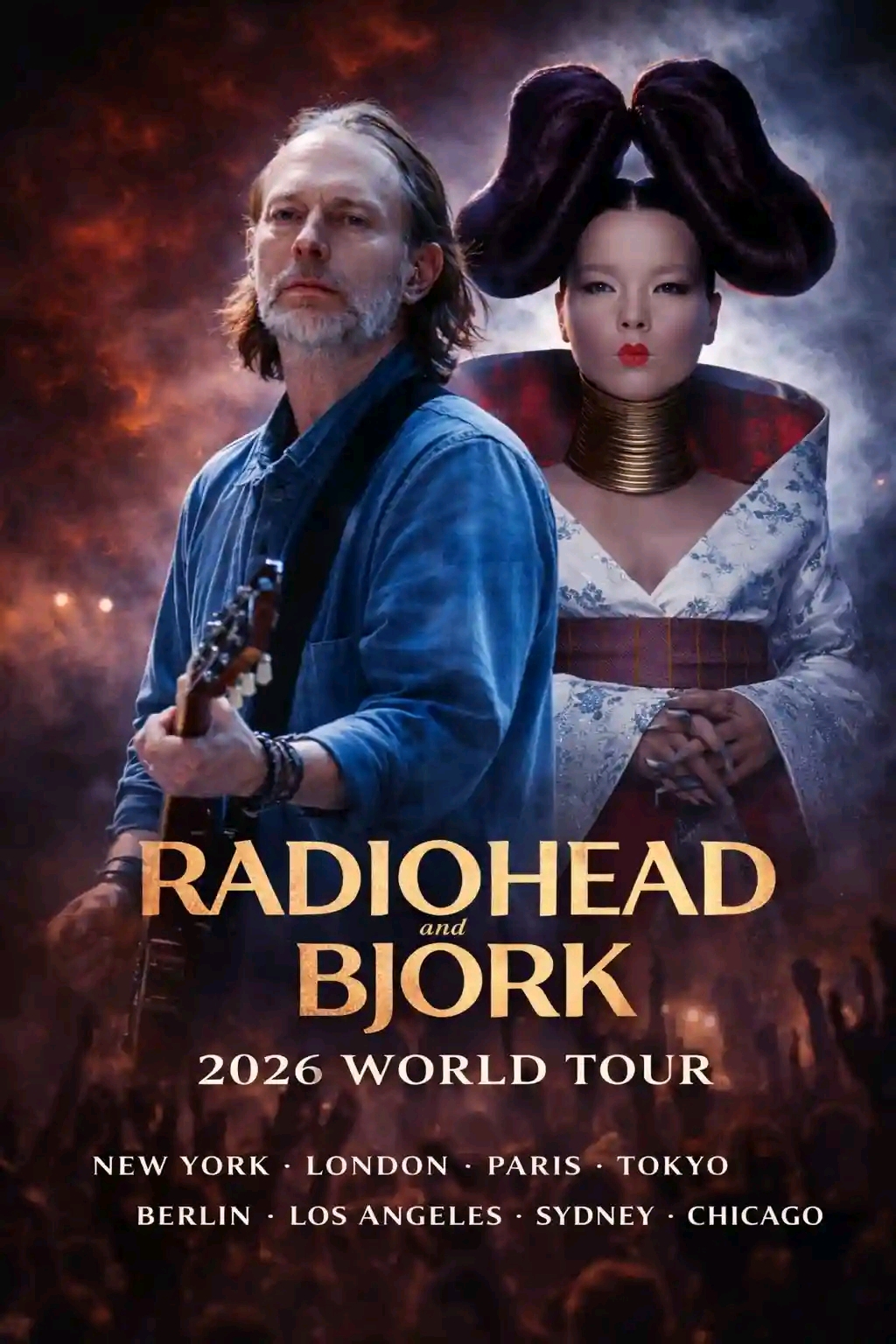
In the ever-evolving landscape of live music, few tours have generated as much curiosity and wonder as the electrifying 2026 world tour featuring Radiohead and Björk. Two artists who have spent decades reshaping the boundaries of sound, both individually and collectively, finally brought their forces together in a live experience that defies easy categorization. What was billed as a “collision of sound and shadow” became much more: a celebration of experimental music, emotional catharsis, and unexpected sonic kinship.
From the moment the tour was announced, fans and critics alike sensed something rare was unfolding. Radiohead, the British alt-rock icons whose music has wandered from guitar-driven dissonance to orchestral ambience, and Björk, the Icelandic visionary whose art embraces glitch, folk, and electronica with fearless creativity, seemed like perfect complements — if not obvious collaborators. Yet the sheer scale and ambition of pairing these two together on tour was unprecedented. It wasn’t a co-headline bill as much as an invitation into parallel artistic universes.
The setlist structure itself became a part of the tour’s narrative. Radiohead opened most nights with selections that leaned into their atmospheric catalogue — deep cuts from Kid A and Amnesiac, interwoven with haunting tracks like “Daydreaming” and “How to Disappear Completely.” These early moments were quiet, introspective, and beautifully raw. They set a tone of introspection, as if inviting the crowd to step into the shadows alongside them.
When Björk took the stage, the energy shifted — though not explosively, but rather with a kind of elemental force. With her magnetic presence and the delicate power of her voice, she drew audiences deeper into an otherworldly realm. Songs from Vespertine and Medúlla interlaced with newer work that incorporated AI-generated harmonies, creating a soundscape that was at once tender and unsettling. It was music that didn’t simply fill space, but altered it.
What truly set this tour apart was the collaborative segments woven throughout the performance. For several songs, Björk joined Radiohead onstage, layering her crystalline vocals over Thom Yorke’s emotive delivery and the band’s shimmering textures. These moments felt like alchemical convergences — as if two distinct musical solitudes had found resonance in the very fractures of rhythm and tone. Tracks like Everything in Its Right Place and Unravel took on new shades of meaning in these arrangements.
Visually, the tour was as daring as the music itself. Stage design featured kinetic light sculptures and drifting fabrics that responded to sound frequencies, dissolving the separation between performance and environment. In many ways, the visuals were metaphors: sound taking shape, shadow becoming texture, the abstract made tangible. Björk’s costume designs — organic yet futuristic — evoked both forest mysticism and quantum possibilities, reinforcing the sense that this was not a concert, but an immersive odyssey.
Critical reception was overwhelmingly positive, with many reviewers calling the tour “a watershed moment in 21st-century performance art.” Commentators noted how both Radiohead and Björk have always lived on the fringes of mainstream expectation — artists who write not for commercial comfort but for emotional truth. Together, they created an experience that was as intellectually stimulating as it was spiritually affecting.
Fans traveled from around the world to witness these shows. For many, it was more than a tour — a pilgrimage. Social media buzz was filled with stories of emotional breakthroughs: the song that helped someone through grief, the light sequence that sparked a moment of clarity, the realization that art still has the power to transform. In an era where live performance sometimes feels commodified, this tour reminded audiences why they fall in love with music in the first place.
Of course, not all moments were tranquil. Some sections of the audience found the experimental transitions challenging — deliberate dissonances, abrupt tempo changes, and extended ambient passages tested patience. But for proponents of adventurous sound, this was part of the beauty. Music that demands attention, that refuses passive consumption, often leaves a deeper imprint on the listener.
One of the most talked-about aspects of the tour was its commitment to sustainability. From electrified fleets of tour buses powered by renewable energy to stage materials designed for reuse, the tour made bold statements about environmental responsibility. Björk and Radiohead have long been vocal about ecological issues, and in this tour they translated advocacy into action — turning every venue into a platform for awareness as much as performance.
By the final leg of the tour, it was clear that something profound had taken place. What began as a daring artistic experiment evolved into a shared cultural moment, uniting people across generations and geographies. Critics began drawing parallels between this tour and the legendary tours of the past — those rare instances when music shifted from being heard to being felt in the collective consciousness.
At its heart, the 2026 world tour of Radiohead and Björk was an affirmation of music’s limitless potential. It wasn’t simply about melody or rhythm; it was about connection, imagination, and the power of sound to illuminate shadowed corners of the human spirit. For fans fortunate enough to attend, and for those who experienced it through recordings and stories, it stood as a testament to the enduring alchemy of daring art.
In the end, this collision of sound and shadow proved that when artists with uncompromising visions come together, they can create something transcendent — a living work of art that reverberates far beyond the stage lights and applause.