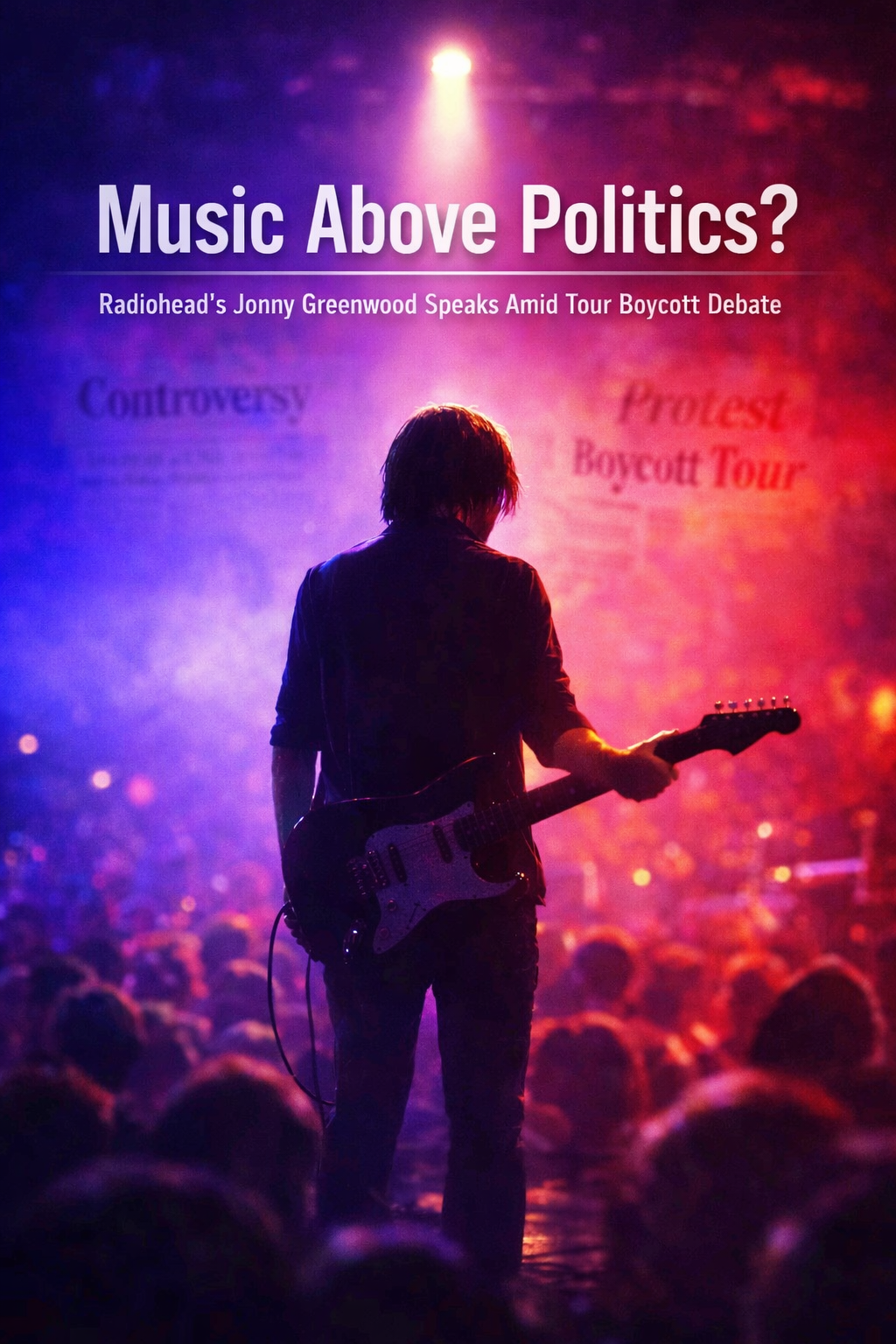
The conversation surrounding music and politics has once again taken center stage, this time involving Radiohead guitarist Jonny Greenwood.
Amid renewed boycott calls tied to past performances and artistic collaborations, Greenwood has made it clear where he stands: he believes music should transcend political divides rather than be confined by them.
The debate reignited following discussions about Radiohead’s history of performing in Israel, particularly their 2017 Tel Aviv show. Activists who support the cultural boycott movement argue that performing in certain regions signals tacit approval of government policies.
Greenwood, however, has consistently framed his position differently — emphasizing artistic independence over political alignment.In a recent interview, Greenwood expressed his view that art should exist beyond the reach of political pressure.
He suggested that if musicians were to judge every collaboration or performance based on governmental actions, creative exchange across borders would become nearly impossible. For him, music represents connection, not endorsement.Greenwood has long been known for his cross-cultural collaborations. His work with musicians from Israel and across the Middle East reflects his fascination with global sounds and traditions.
He has previously worked with Israeli musician Dudu Tassa, blending rock with traditional Middle Eastern influences — a partnership rooted in artistry rather than ideology.
At the heart of Greenwood’s argument is the belief that nationality does not define a musician’s values. He maintains that creative partnerships are about shared artistic language, not shared politics.
In a world often divided by policy and power, Greenwood sees music as one of the few spaces where dialogue can flourish freely.The boycott debate has not only stirred public discourse but also drawn attention to internal nuances within the band. Thom Yorke, Radiohead’s lead singer, has previously spoken critically about certain political leaderships and has suggested he would reconsider performing in Israel under current circumstances.
These differing tones reflect the complexity of balancing activism with artistic autonomy.Despite the controversy, Radiohead’s recent touring activity has been met with strong audience support. After several years of relative quiet from the band, fans welcomed their return to live stages.
Greenwood himself admitted surprise at how fulfilling the performances felt after such a long break.Still, questions remain about the band’s future. Greenwood has indicated that while the recent tour was rewarding, there are no immediate plans locked in for another global run. Large-scale tours require years of logistical preparation, and the band members continue to focus on individual creative pursuits.
Outside of Radiohead, Greenwood’s career remains vibrant. He has earned widespread acclaim for his film scoring work, collaborating with celebrated directors and earning prestigious award nominations. His ability to shift between experimental rock and orchestral composition underscores the breadth of his artistic vision.For fans wondering about new Radiohead material, Greenwood’s comments suggest cautious optimism rather than certainty.
While there is no confirmed album on the horizon, the band has not ruled out future recordings. As with much of their career, Radiohead appears to move according to inspiration rather than external expectation.
The broader cultural conversation sparked by Greenwood’s remarks reflects a recurring tension in modern art: should musicians take explicit political stances, or should they preserve art as neutral ground? For some, silence can be interpreted as complicity.
For others, creative expression itself is a form of resistance against division.Ultimately, Greenwood’s perspective highlights his enduring commitment to artistic freedom.
Whether or not one agrees with his stance, his words have reignited a vital discussion about where music stands in an increasingly polarized world. As Radiohead’s future unfolds, one thing remains certain — their work continues to provoke thought, conversation, and powerful emotional resonance across the globe.